
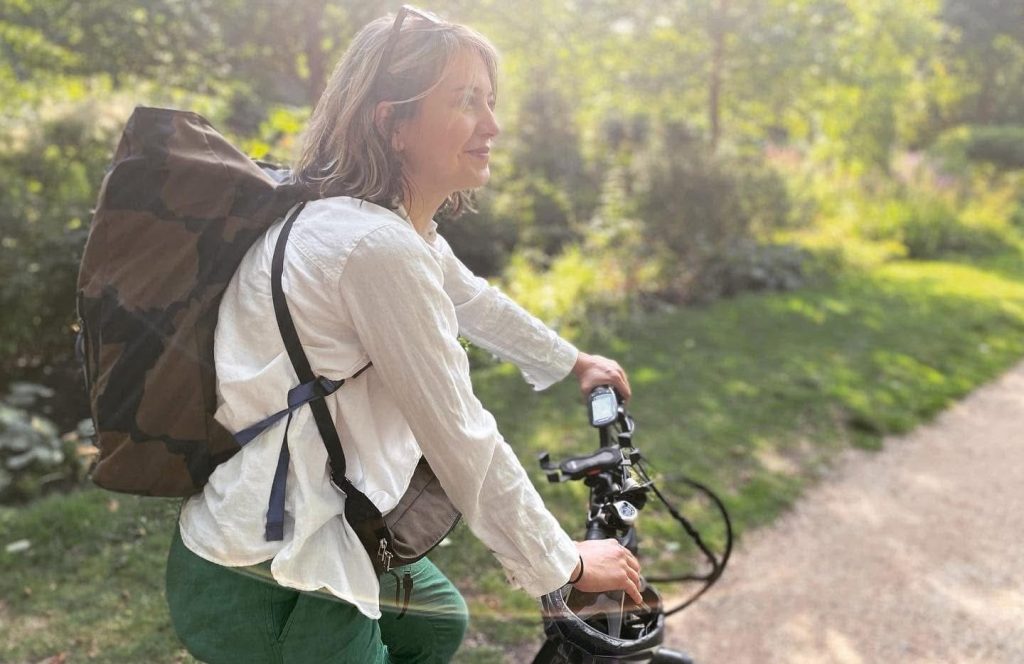
Anya cycling in Bushy Park near her home
Change often begins before someone has consciously decided to do anything differently. There can be a growing sense of restlessness, exhaustion or discomfort, or a feeling that life no longer feels quite right in its current form. Sometimes this becomes attached to the idea of moving home, although the house itself is often only part of the story.
Over the years, both through working in housing and through my own experiences and conversations, I’ve become increasingly aware of how closely our homes are tied to identity, routine, memory and wellbeing. People often speak about moving as though it’s mainly a practical or financial decision, but it rarely feels that straightforward when you’re actually living through it.
I think this is partly because homes gradually absorb layers of life and meaning over time, often without us fully noticing. People can become attached not only to the physical place itself, but to the routines, memories, identities and expectations associated with it. This is probably why moving can feel emotionally complicated even when the practical reasons for doing it are clear.
At other times, someone may feel drawn towards a different kind of life but struggle to articulate exactly what’s missing in their current one. I’ve noticed that people are often trying to resolve several things through the idea of moving, even if they initially describe the decision in practical terms. Someone may talk about needing more space, while underneath that there is exhaustion, loneliness, pressure or a growing sense that the way they’re living no longer feels sustainable.
A friend I once helped while she was trying to buy her first home through the Help to Buy scheme viewed a long series of small new-build studios and one beds that all felt quite similar. The scheme limited the kinds of homes available to her and, although some of the flats were perfectly nice, none of them really felt right.
She had studied art at Kingston University and was drawn to older spaces with more character, but had started to feel that finding somewhere like that within budget probably wasn’t realistic. I then came across what was classed as a new-build studio in a converted historic stables near Bushy Park and sent it over to her.
It had mezzanine levels above each end of the main living space, which made it feel much larger and more flexible than most of the studios she’d seen. The layout was unusual and probably wouldn’t have suited everyone, but she immediately felt differently about it. I remember thinking afterwards how difficult it can be to reduce decisions about home to lists of practical requirements or square footage alone, because people are often responding to atmosphere, identity and the feeling they imagine having in a place as much as the place itself.
I’ve also seen people begin considering moves after children leave home, after divorce, following health problems or during periods where priorities begin changing. Sometimes people are excited by the possibility of change and frightened by it at the same time. Sometimes they’re not even sure whether they genuinely want to move, or whether they need something about life to change more broadly.
This is partly why I think reflective planning conversations can be valuable during periods of transition. Not because every decision needs deep analysis, but because they can help people better understand what is practical, what is emotional and what may be coming more from external expectation than from their own needs or desires.
In some cases, the outcome may well be a move. In others, clarity may come through changing aspects of life without relocating at all. Either way, I think there’s value in slowing the process down enough to properly consider not only where someone wants to live, but how they want life to feel on an ordinary day-to-day level.


Leave a Reply